
RNA Pull-Down Assay (II) | Principle, Experimental Protocol, and Data Interpretation
Updated: Apr 6
Technical Note | TACT Genomics, April 04, 2026
Discover RNA–Protein Interactions with High Sensitivity & Confidence.
Identify RNA-binding proteins (RBPs) faster, more reliably, and cost-effectively. From discovery to validation, TACT Genomics provides complete solutions for RNA pull-down assays.
Introduction
Current approaches for studying RNA–protein interactions fall into two main categories:
RNA-centric methods – identifying proteins that bind to a target RNA
Protein-centric methods – identifying RNAs that bind to a target protein
The RNA pull-down assay belongs to the first category. In this method, the RNA of interest is labeled (typically via in vitro transcription), immobilized on a solid support through its tag, and incubated with protein samples. After washing and elution, proteins that bind to the target RNA are isolated.
Since RNA pull-down and RIP-seq are primarily screening techniques, downstream validation is typically performed using Western blot (WB), PCR, or qPCR.
Principle of RNA Pull-Down
RNA pull-down is an in vitro method used to identify proteins that bind to a target RNA.
A traditional biotin-labeled RNA probe is generated via in vitro transcription
The RNA is immobilized on beads (e.g., streptavidin magnetic beads)
The RNA–bead complex is incubated with cell lysate
RNA-binding proteins are captured on the beads
Non-binding proteins are washed away
RNA–protein complexes are eluted
These complexes can then be analyzed by:
Western blot (WB) for known targets
Mass spectrometry (MS) for discovery of unknown proteins
Experimental Protocol
Overall workflow: RNA probe preparation → Protein extraction → Bead preparation → RNA pull-down → Protein elution → Detection (WB or MS)
RNA Pull-down Assay Workflow
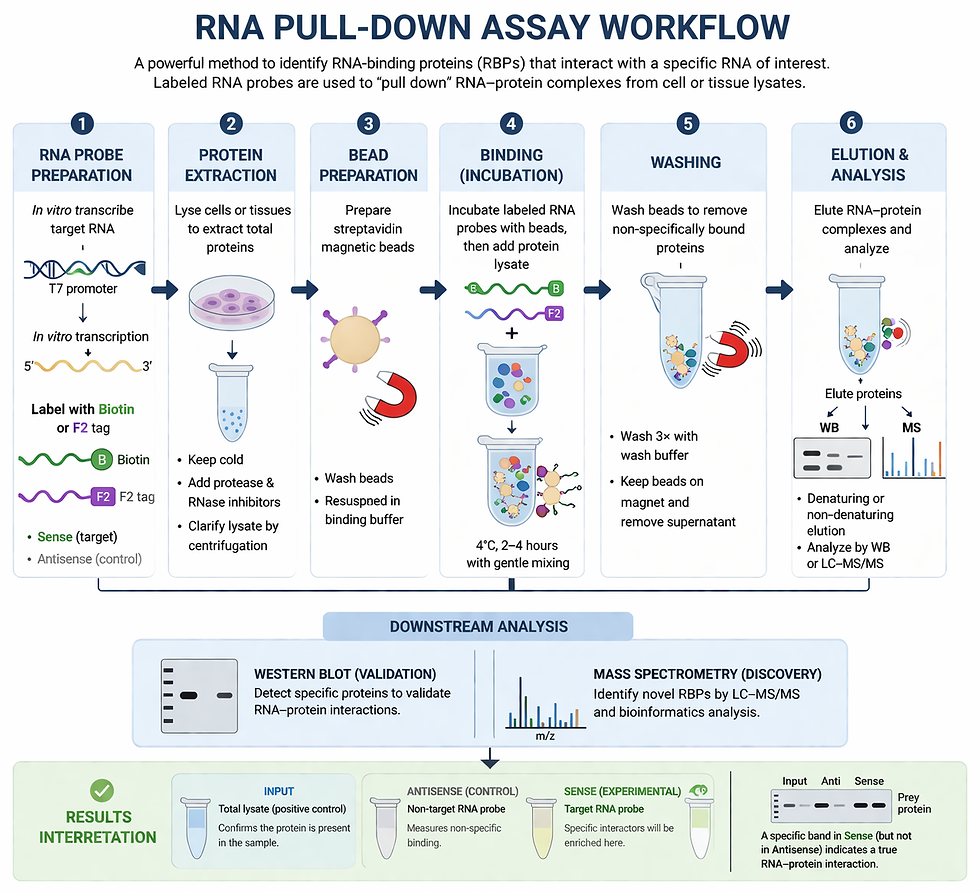
1. RNA Probe Preparation
Currently, RNA probes are commonly labeled with biotin, which can be costly and complex. An alternative novel method uses an F2 RNA tag, which simplifies labeling and reduces cost.
1.1 Biotin-Labeled RNA Probe
Steps:
Construct RNA expression plasmid and verify by sequencing
Prepare DNA template with T7 promoter (TAATACGACTCACTATAGGG)
Generate sense (experimental) and antisense (control) templates by PCR (Universal Ultra-High Fidelity Phanta PCR Master Mix)
Perform in vitro transcription with biotin-UTP
Treat with DNase I to remove DNA template
(Optional) Purify RNA to remove free biotin-UTP
Measure RNA concentration and assess quality by gel electrophoresis
Store at −80°C or use immediately
1.2 F2-Labeled RNA Probe
Similar to biotin labeling, but the F2 sequence (~16–17 nt) is incorporated into primers.
No need for biotin-UTP or RNA purification.
Lower cost and simpler workflow.
Comparison: F2 vs. Biotin Labeling
Feature | F2-Labeled RNA | Biotin-Labeled RNA |
Label | 16-nt RNA tag | Biotin |
Efficiency | ~100% | Decreases with RNA length |
Application | In vitro & in vivo | In vitro only |
RNA types | Linear & circular RNA | Linear RNA |
Cost | Low | High |
Ease of use | Simple | More complex |
✅ Notes
RNA is prone to degradation → prepare probes fresh (same day or one day prior)
Very short (<300 bp) or long (>4 kb) RNAs are more difficult → consider fragmentation
2. Total Protein Extraction
2.1 Cell Samples
Culture and harvest cells
Wash with cold PBS
Lyse with buffer containing protease and RNase inhibitors
Incubate (4°C, 30 min or sonication)
Centrifuge and collect supernatant
Reserve input sample and divide into experimental/control groups
2.2 Tissue Samples
Wash tissue with cold PBS
Grind in liquid nitrogen
Lyse and process similarly to cell samples
Collect supernatant and divide into groups
3. Magnetic Bead Preparation
Wash beads with buffer
Resuspend and split into experimental and control groups
4. RNA Pull-Down
Denature RNA probes (95°C, 3 min), then cool
Incubate RNA with beads
Wash to remove unbound RNA
Add protein lysate and incubate (4°C, 2–4 h)
Wash beads thoroughly (typically 3 times)
Retain beads with bound RNA–protein complexes
5. Protein Elution
5.1 Denaturing Elution
Add SDS-PAGE loading buffer
Heat (95°C, 5–10 min)
Collect supernatant for WB or MS
5.2 Non-Denaturing Elution
Elute with buffer at room temperature
Collect proteins for downstream applications
✅ Notes
Use denaturing elution if yield is low
Protein amount is often low → silver staining recommended
6. Protein Detection
6.1 Western Blot (WB)
Detect specific target protein (Prey)
Presence of a clear band indicates interaction (High Sensitive SuperFemto ECL Master Mix)
6.2 Mass Spectrometry (MS)
Identify differential proteins between experimental and control groups
Used for discovery of novel RBPs
Data Interpretation
Groups:
Input: total protein lysate (positive control)
Antisense: control probe pull-down
Sense: target RNA probe pull-down
Interpretation Logic:
Check Input
Must detect target protein
If not → extraction failed
Compare Sense vs. Antisense
Sense (+), Antisense (−/weak) → specific interaction
Both positive → nonspecific binding
Both negative → possible probe or binding issue
✅ Troubleshooting
High background: increase washing, optimize probe concentration, block beads
No signal: verify probe labeling and binding conditions
RNA Pull-Down Products & Services (TACT Genomics)
Kits
Product | Catalog No. |
FI8701 | |
Biotin RNA Pull-Down Kit | FI8702 |
FI8710 |
Services
Service | Description |
RNA Pull-Down WB (Validation) | Probe preparation + WB detection |
RNA Pull-Down MS (Discovery) | Probe prep + pull-down + LC-MS/MS analysis |
Conclusion
The RNA pull-down assay is a powerful and versatile method for identifying RNA-binding proteins. By combining optimized probe design, rigorous controls, and proper downstream validation, researchers can confidently characterize RNA–protein interactions.
💡 Why Researchers Choose TACT Genomics
Proven performance in RNA–protein interaction studies
Strong technical support
Competitive pricing
Fast turnaround & reliable supply
📞 Get Started Today
Ready to accelerate your RNA–protein research?
👉 Request a Quote👉 Request a Sample👉 Talk to a Specialist
TACT Genomics Inc.
📞 +1 (647) 868-7266
Comments